Symbolic world models (e.g., PDDL domains or executable simulators) are central to model-based planning, but training LLMs to generate such world models is limited by the lack of large-scale verifiable supervision.
Current approaches rely primarily on static validation methods that fail to catch behavior-level errors arising from interactive execution.
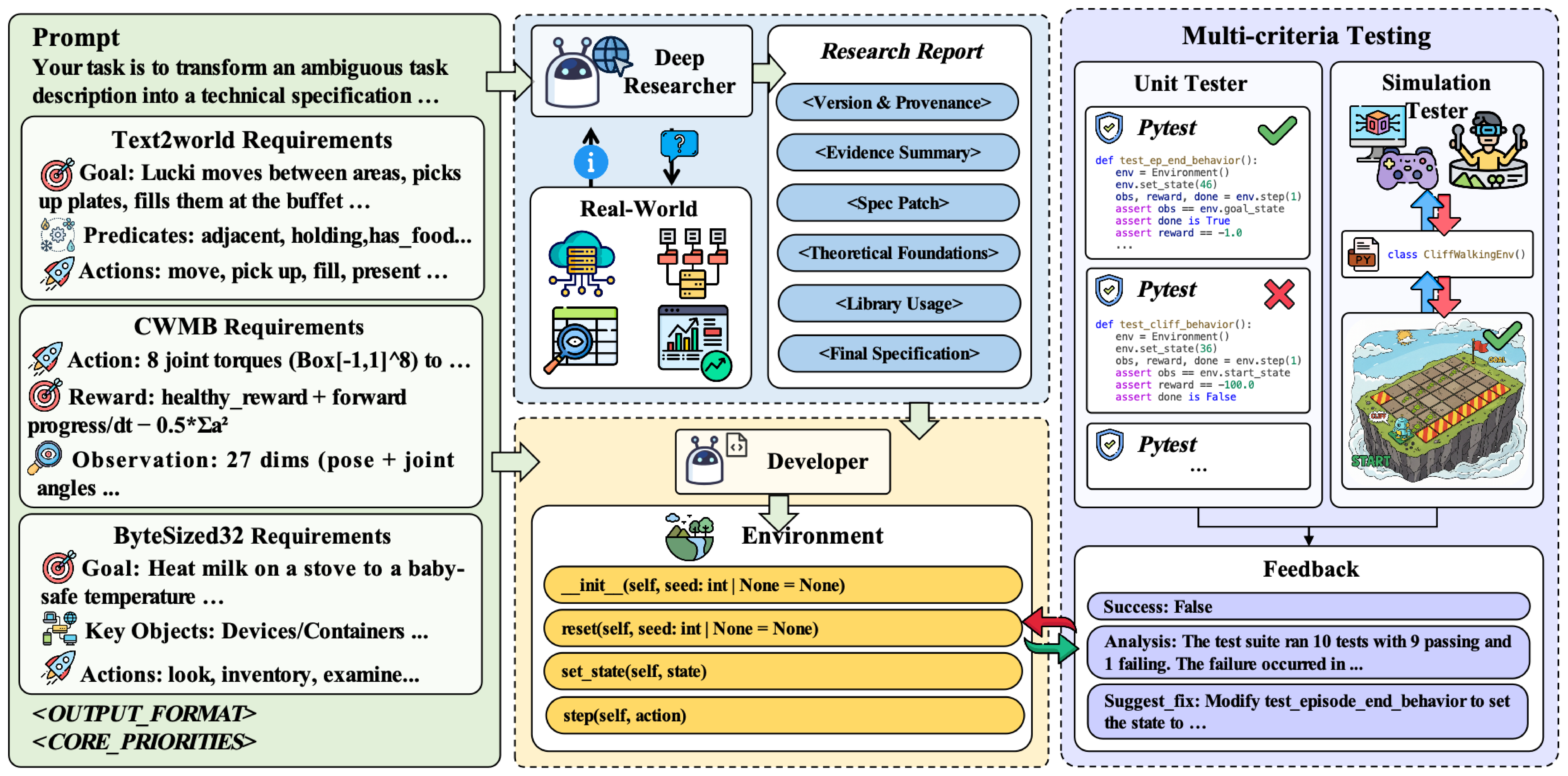
In this paper, we propose Agent2World, a tool-augmented multi-agent framework that achieves strong inference-time world-model generation and also serves as a data engine for supervised fine-tuning, by grounding generation in multi-agent feedback.
Agent2World follows a three-stage pipeline:
(i) a Deep Researcher agent performs knowledge synthesis via web search to address specification gaps;
(ii) a Model Developer agent implements executable world models; and
(iii) a specialized Testing Team conducts adaptive unit testing and simulation-based validation.
Agent2World demonstrates superior inference-time performance across three benchmarks spanning both PDDL and executable code representations, achieving consistent state-of-the-art results.
Beyond inference, the Testing Team serves as an interactive environment for the Model Developer, providing behavior-aware adaptive feedback that yields multi-turn training trajectories.
Fine-tuning on these trajectories substantially improves world-model generation, yielding an average relative gain of 30.95% over the same model before training.